Down to Earth
Making Space for Reality in NASA Imagery by Andrew Scheinmann
Charles and Ray Eames’ landmark film Powers of Ten begins with a bird’s-eye view of a single square meter of Chicago. Two very mid-twentieth century people settle in for a picnic, what our narrator exuberantly tells us is “the start of a lazy afternoon early one October,” and then the camera zooms out, launching us into the sky. Every ten seconds, our visible area expands outward by a magnitude of ten. Our two protagonists disappear into specks along the shores of Lake Michigan, and then the sprawl of Chicago fades into an outline of the deep-green Midwest. Eddies of cloud soon smear over the continent. Land and sea meld, blend, become one kaleidoscopic object. That famous Blue Marble, the whole Earth, appears in the vacuum of space, shriveling us to nothing before it too disappears into the abyss.
The iconic Milky Way, an Impressionist swirl of dabbed paint, withers to just a fleck of light in a field of countless others like it. At 1024 meters or 100 million light years out, we hit a wall of almost pure black — the end of human vision circa 1977, the year the film was completed — and head home, back to our lazy pair in the grass. Then we slide into a man’s hand with a microscope, where the glowing orbs and helixes of his cells, DNA, and atomic particles could easily be confused for massive objects in deep space.
Tying all of these images together with a simple voice-over, Powers of Ten made the space age accessible to the general public, narrating a plunge into science not long after the moon landing debuted in every living room in America.01 It also placed humanity squarely in its center, with its narrative set in the quintessential twentieth-century city. The human hand, a symbol of both work and ingenuity, is effectively the star of the show. Everything, the film suggests, for must be connected back to our earthly bodies us to truly understand. Prefiguring the hubris-shrinking philosophy of Carl Sagan in Pale Blue Dot by about two decades, the screenwriter and director Paul Schrader wrote of Powers of Ten that it allowed the viewer to “think of himself as a citizen of the uni- verse.” The nine-minute film, he added, “gives the full impact — instinctual as well as cerebral — of contemporary scientific theories.”
Four decades later, much has changed in what defines that full impact, especially on the zoomed-out end of things. For one, the black wall at 1024 is no longer the end of our collective sight. The Hubble Space Telescope, or HST, launched in 1990 by NASA and the European Space Agency, now brings us up to at least 1026 meters, adding nine billion nine hundred million light years more to our eyes. Add to that the three other so-named Great Observatories launched in the nineties and early aughts, along with the New Horizons interplan- etary space probe and the Curiosity rover currently cruising on Mars, and stunning photographs of planets, moons, and galaxies far, far away have become a steady drip.
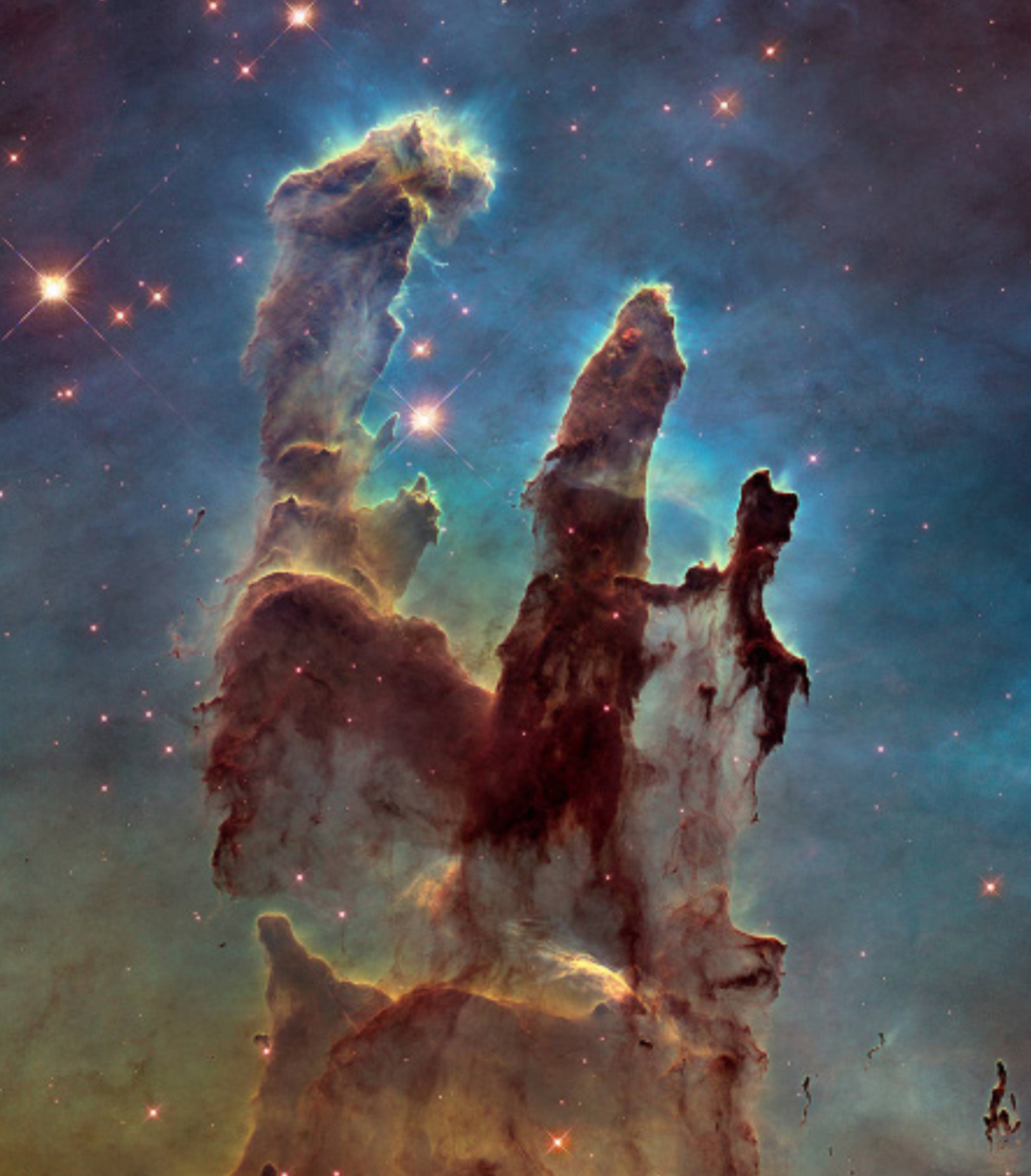
Every so often, one of these drops pierces the cultural con- sciousness, sometimes so much so that a single image becomes a metonym for all of space exploration. The iconic Pillars of Creation,
a surrealistic photograph of gas towers in the Eagle Nebula more than five light-years tall, made waves when it appeared in 1995, a huge public-relations boon for NASA and astronomy more generally. The image, however incomprehensible or bizarre to its non-astronomer public (how does anyone even begin to understand a five light-years- tall anything?) was inescapable, reprinted the world over on pillows, tee-shirts, and postage stamps. Endlessly reproducible, Pillars of Creation refamiliarized a general audience with space by sheer viral- ity alone. Around the same time, our aesthetic culture of images for images’ sake, postmodernism, was thoroughly theorized and critiqued. Images, the theorist Jean Baudrillard declared, are not representative of reality but, for those accustomed to staring at screens and photos, the actualization of reality itself. Images of deep space are not repre- sentative of distant, inconceivable space — for all of us here on Earth, they are space.
1996
by Amanda Pickens
Space Jam, The Macarena, Surge, and Lunchables — it was 1996, and these were the lifestyle choices needed for that fourth grade “cultural capital.” Not only were Pizza Lunchables delicious, they instantly asserted the appropriate level of pretense amongst one’s friends at the lunch table. Little Debbies and Capri Suns didn’t hurt either.
When I think back to my fuzziest childhood memories, I’m taken to this year. As the new kid at school, I began to consciously navigate my social landscape. Suddenly I cared not only about clothes and music, but also what appeared in my lunchbox. On lucky days when I opened my lunchbox to brand name junk foods with cartoon- plastered packaging, I felt like a player at the lunch table. While I fondly remember these treats, I’m also repulsed by their sugar content and lab-conceived ingredient lists. I actively avoid these aisles at the grocery store, yet I secretly love their neon colors and basic package design.
To pay homage to these treats while highlighting my conflicted relationship with them, I’ve photographed these foods in all their saccharine beauty. Deconstructed Nutty Buddies, Fruit by the Foot wrappers, and Cheeto dust play alongside brightly colored acrylic containers, pat- terned backdrops, and paper napkin surfaces. Because despite their synthetic ingredients and empty calories, they’ll forever hold a wholesome place in my heart.




Here Nor There
The Mythology of the U.S. National Borders
The United States’ silhouette on a map feels natural, solid, and timeless. Most Americans easily identify and recognize its shape, so it seems absurd to suggest the borders that bind this outline could be fuzzy.01 This aversion is a result of our fixed perspective. American borders have been roughly the same for 150 years, and most international borders have stayed relatively consistent in the three decades since the end of the Cold War. The time when borders were in flux seems so distant that it’s hard for Americans to conceptualize borders without perma- nence. The clarity of our perceived borders is an illusion. Historical examination of national borders reveals them to be liminal, porous, and arbitrary, both in their theoretical conception and in their practical application.
An intellectually honest examination of the United States’ national borders should start with a clear definition of nation. Nationalists often blend and stretch the definitions of nation, state, and country to suit their agendas. Continual conflation of these three concepts distorts their meaning and oversimplifies the subtle, but important, distinctions between them.
Nation is usually defined through two ideological frameworks. The first focuses on “objective” factors, which are testable and quantifiable, like languages or longtime geographic bindings. The second focuses on more subjective factors, like a shared sentiment of unity. Nationalists tend to prefer the former definition. (While no group holds unanimous views on any subject, some generalizations are helpful for the sake of analysis.) Nationalists, especially neo-nationalists, white nationalists, and Brexiteers, who have risen to ideological prominence in the last five years, tend to view nations as measurable and objective “things.” Like their mid-twentieth-century totalitarian ideological forebears, modern nationalists claim the distinctions among nations to be self-evident, timeless, and enforceable.